
The Scenario Playing Out Across Fleets Right Now
A driver gives notice on a Friday. You find out Monday. The truck sits Tuesday while your team posts a listing and waits for applications.
Three candidates apply by Wednesday. Your team calls Thursday. One number goes to voicemail. One driver says they accepted an offer two days ago. The third says they are still thinking about it, but has two interviews scheduled for the following week.
Your team spent a week on a process that produced nothing. The truck lost revenue every single day.
This is reactive recruiting. And it is one of the most expensive habits in trucking.
The Real Cost of an Empty Seat
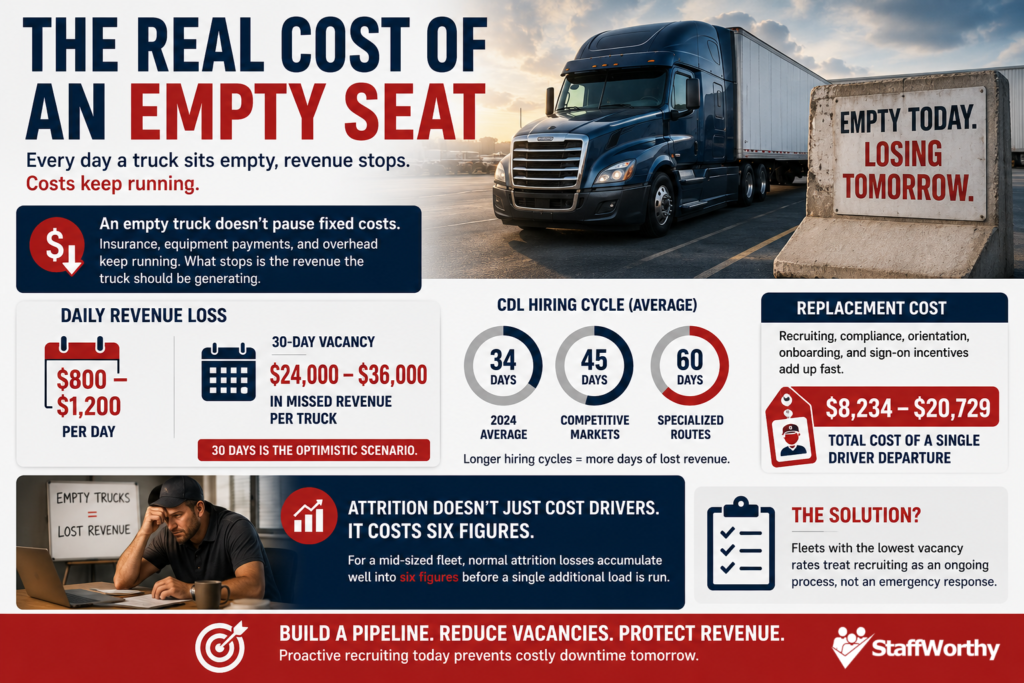
An empty truck does not pause your fixed costs. Insurance, equipment payments, and overhead keep running regardless of whether a driver is behind the wheel. What stops is the revenue the truck should be generating.
Industry estimates put daily revenue loss at $800 to $1,200 for every vacant seat. Over a 30-day vacancy, that is between $24,000 and $36,000 per truck in missed revenue.
And 30 days is the optimistic scenario. The average CDL hiring cycle ran 34 days in 2024. In more competitive markets or for specialized routes, the cycle routinely extends to 45 or 60 days.
Add the replacement cost and the number grows faster. Recruiting expenses, compliance screening, orientation, onboarding, and sign-on incentives push the total cost of a single driver departure to between $8,234 and $20,729. For a mid-sized fleet dealing with normal attrition, those losses accumulate well into six figures before a single additional load is run.
We covered the full picture in our breakdown of driver recruitment strategy, including why the companies with the lowest vacancy rates all treat recruiting as an ongoing process, not an emergency response.
Read more: https://staffworthy.com/driver-recruitment-strategy-trucking/
Your Competitors Are Calling the Same Drivers
Reactive recruiting means starting from zero every time a seat opens. There is no warm list of pre-screened candidates. No one in the pipeline who already knows your routes, your pay structure, or what makes your operation worth working for.
So your team posts and waits. Meanwhile, your competitors are calling the same pool of drivers. And those drivers are not holding out for the best offer on paper. Many CDL drivers receive multiple job offers within days of starting their search. The carrier who responds first gets the conversation. The one who responds fastest usually gets the hire.
A proactive recruiting approach changes this entirely. When a pipeline exists before the vacancy, the work of screening and initial conversation is already done. When a driver gives notice, the team reaches out to candidates already in progress, not strangers from a fresh job post.
Time-to-fill drops because the preparation happened before the emergency, not during it.
Speed Is the Competitive Advantage
Even with a pipeline in place, the speed of response once a driver applies determines how many of those leads convert to hires.
Research in CDL recruiting shows the highest response rates come from contact made within the first five minutes of an application submission. Most fleets wait hours. Some wait days.
Think about what happens in those 48 hours of delay.
A driver applies Monday morning. No call Monday. Tuesday passes with nothing. Wednesday, two other carriers reach them and schedule phone screens. Thursday, one of those carriers makes an offer. Friday, your team finally calls and gets no answer.
The contact rate problem compounds this further. Fleets relying on a single call attempt typically connect with only 40 to 50 percent of their leads. A structured outreach approach, calling within minutes of application, following up within 24 hours, and sending a text introduction, pushes contact rates above 70 percent.
The gap between those two numbers represents a significant share of the leads your company already paid to generate, leaving the funnel before a real conversation ever started.
Recruiting Has to Match When Drivers Are Available
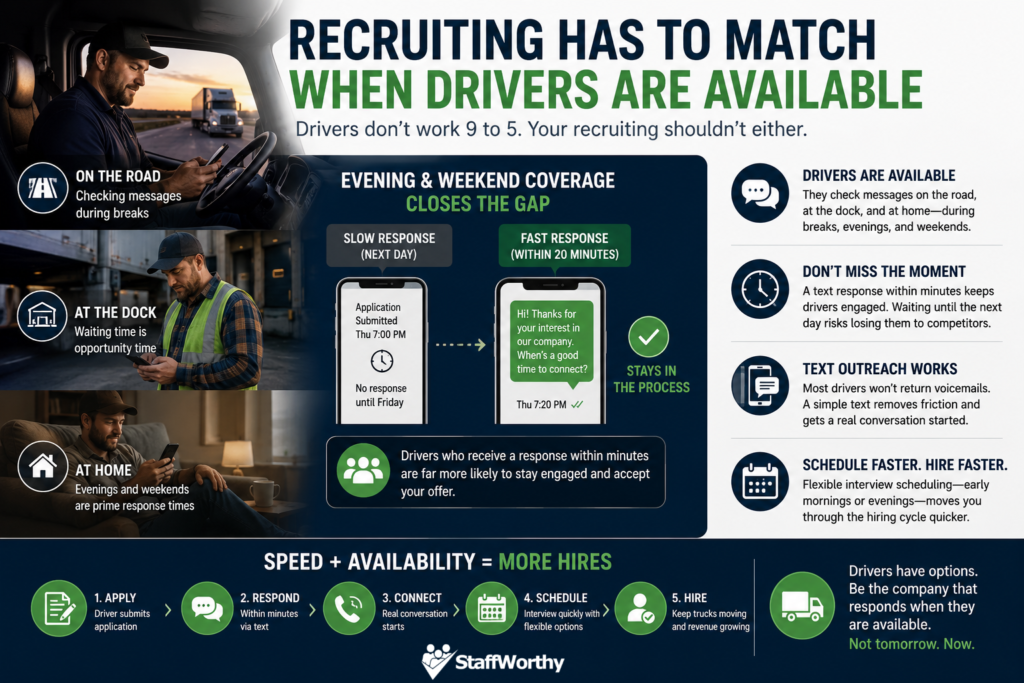
Most CDL drivers are not sitting at a desk during standard business hours. They are on the road, in a dock queue, or at home resting after a shift. They check messages during breaks, in the evening, and on weekends.
A recruiting operation running Monday through Friday, 8 to 5, misses large portions of the available candidate pool.
Evening and weekend coverage closes this gap. A driver who submits an application at 7 PM on a Thursday and receives a text response within 20 minutes stays in the process at a much higher rate than one who waits until Friday morning for a call.
Text outreach matters here as well. Most drivers will not return a voicemail from an unfamiliar number. A brief, professional text introducing your company and asking for a good time to connect removes the friction. The driver responds on their own schedule, and the conversation starts from a more natural place.
Interview scheduling is the final chokepoint. Every day between application and interview is a day the candidate is also talking to other carriers. Fleets offering flexible scheduling, including early morning and evening availability, consistently move faster through the full hiring cycle.
What Proactive Recruiting Looks Like in Practice
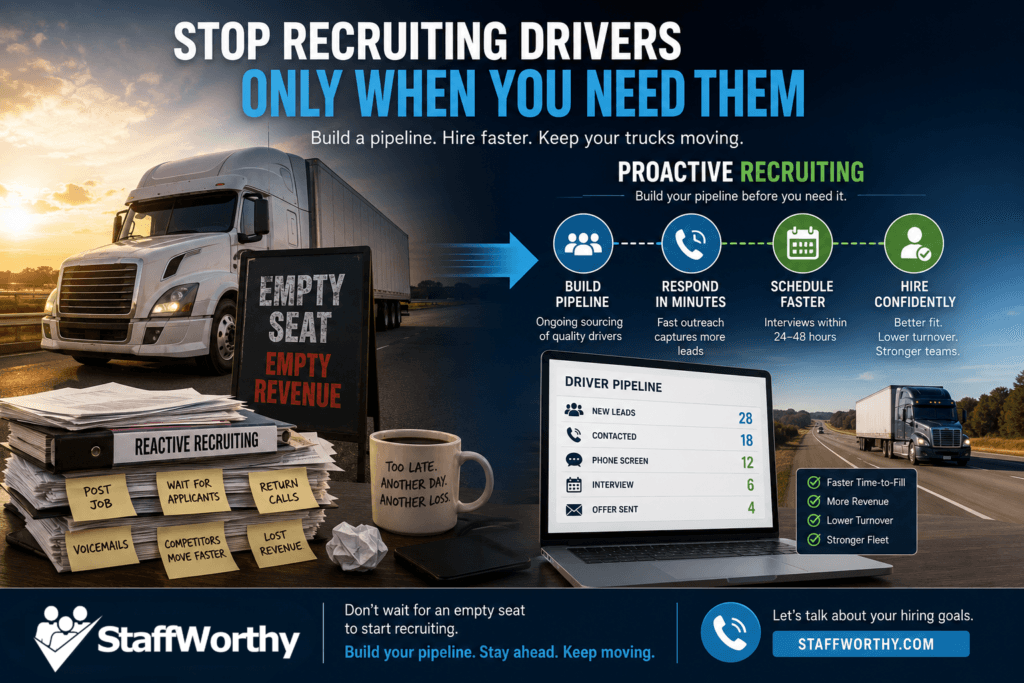
Proactive recruiting is consistent, not complicated. The team works the pipeline before the vacancy opens. Applications get responses in minutes, not days. Text outreach runs alongside phone calls. Coverage extends into evenings and weekends. Interview scheduling moves within 24 to 48 hours of first contact.
One fleet StaffWorthy worked with stopped waiting for open seats to trigger recruiting activity. They built a standing pipeline and maintained it continuously. When a driver gave notice, the team reached out to pre-screened candidates who had already expressed interest. Time-to-fill dropped. Revenue lost between drivers shrank with it. The full story is here.
Read the case study: https://staffworthy.com/how-a-small-trucking-company-eliminated-recruitment-headaches-and-boosted-growth-with-staffworthy/
Sustaining this kind of effort requires either consistent internal capacity built specifically for it, or a recruiting partner whose model is designed to maintain the pipeline on your behalf. Our post on pay-per-hire models explains how a performance-based structure keeps those costs tied directly to actual results.
Read more: https://staffworthy.com/why-pay-per-hire-is-the-smartest-move-for-cdl-fleets-in-2025/
Closing Thought
Reactive recruiting is expensive because urgency eliminates options. When a seat is empty and revenue is bleeding, the pressure to hire someone, anyone, is real. That pressure leads to rushed decisions, poor fit, and early turnover, which restarts the entire cycle.
Fleets breaking out of the cycle are not spending more on recruiting. They are building a process designed to run before the emergency, respond faster than the competition, and keep qualified candidates engaged long enough to actually convert.
The drivers are out there. The question is whether your process reaches them first.
Let’s talk about how StaffWorthy can support your hiring goals.
Visit staffworthy.com or contact us to start the conversation.
About StaffWorthy
StaffWorthy is a U.S.-based Recruitment Process Outsourcing provider specializing in CDL driver and owner-operator hiring. Our recruiter pods operate as an extension of your team, managing sourcing, screening, outreach, and pipeline on a flexible, performance-based model. U.S. project managers work alongside our skilled nearshore delivery team to give fleets the coverage and response speed to compete in today’s driver market.


[…] AV recruiting requires structured candidate engagement through phone, SMS, and email, easy interview scheduling, clear next steps, and defined follow-up intervals. The objective is to […]