Autonomous vehicle companies build some of the most advanced transportation technology in the world. Scaling the technology still takes people.
As autonomous vehicle (AV) companies expand testing and commercial operations across the United States, they need vehicle operators, test drivers, fleet support staff, field operations crews, and technicians.
This creates a specific challenge for autonomous vehicle recruiting. You are hiring for more than driving ability. You need people who operate safely, follow detailed procedures, work alongside new technology, stay alert through long shifts, and meet strict driving-history requirements. When you need hundreds of these hires across several markets, a traditional recruiting process slows your launch.
StaffWorthy started in CDL driver recruitment, one of the most heavily regulated hiring environments in the country. As automation reshapes transportation jobs, our work has expanded into AV and emerging mobility roles. Many of our CDL screening disciplines transfer directly.
AV Technology Is New. Safety-Critical Hiring Is Not.
The technology changes fast. The central hiring question stays the same. Who should you trust around the vehicle?
Transportation employers have asked this for decades. The Federal Motor Carrier Safety Administration (FMCSA) regulates commercial motor vehicle drivers on qualifications, licensing, hours of service, drug and alcohol testing, vehicle inspection, and safety performance.
The scrutiny exists for a reason. FMCSA’s preliminary 2024 data records more than 156,000 crashes involving large trucks and more than 4,600 deaths. Safety in transportation is more than an HR checkbox. Hiring decisions carry real consequences on the road.
AV operations differ from commercial trucking and fall under different regulatory frameworks. The emphasis on safe operators carries over. California, one of the most established AV testing states, requires each AV test driver to know the limitations of the autonomous technology and to operate the vehicle safely in every condition the vehicle faces on public roads.
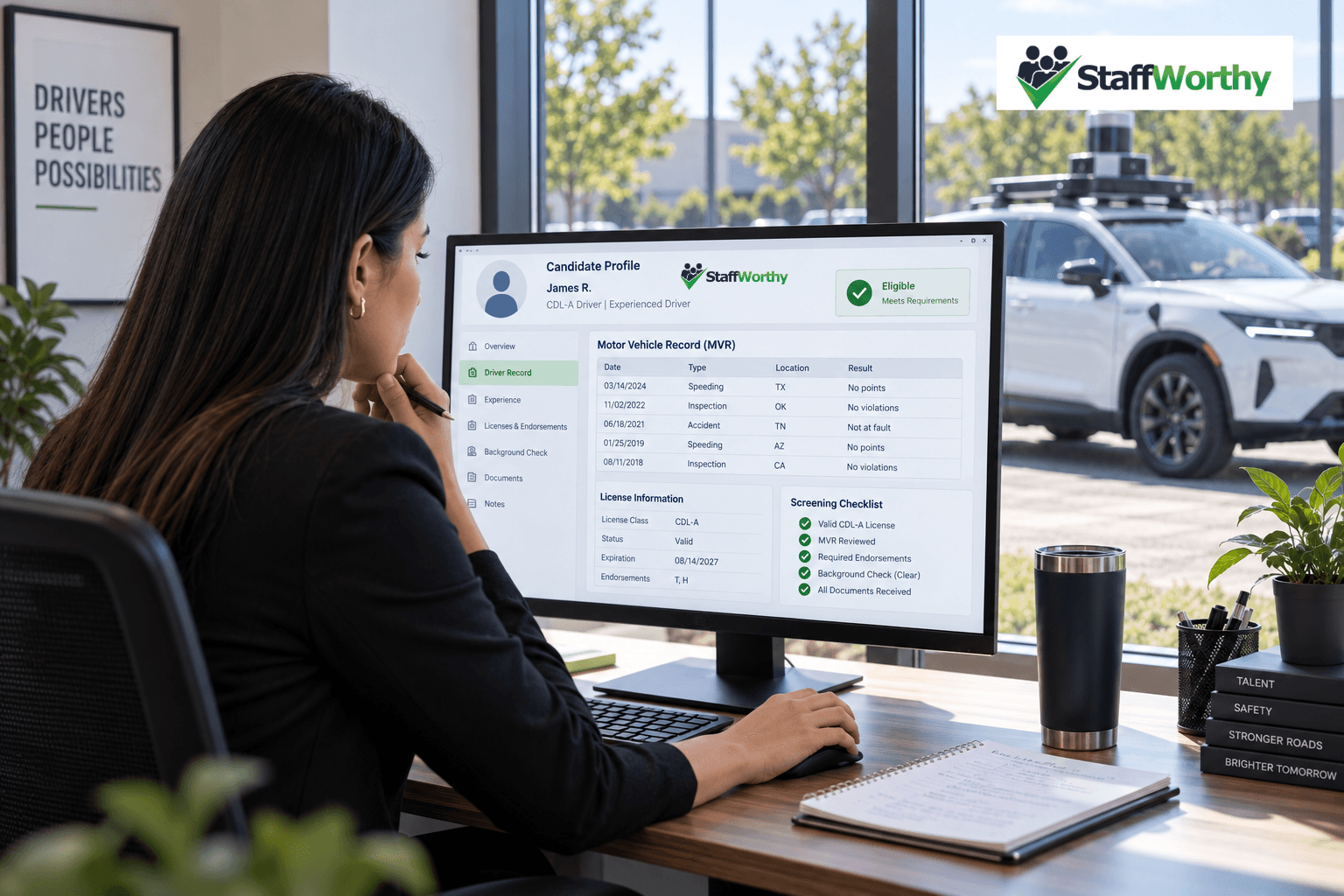
California also sets concrete driving-history standards. Each AV test driver must have held a valid license for the prior three years with no more than one violation point, no at-fault crash causing injury or death, and no DUI conviction in the past ten years. Drivers must meet these standards continuously, and manufacturers track each record through the state’s Employer Pull Notice program. Those are MVR screening criteria, the same work CDL recruiters do every day.
As of August 12, 2026, the California DMV lists 28 companies with permits to test autonomous vehicles with a driver on public roads.
California’s Heavy-Duty AV Rules Bring CDL Standards Into AV Hiring
The overlap with trucking keeps growing. On April 28, 2026, California adopted rules opening public roads to heavy-duty autonomous trucks. A manufacturer must log at least 500,000 autonomous miles with a safety driver before applying to test a heavy-duty truck without one.
The safety drivers in those programs face trucking-grade requirements. Test drivers of heavy-duty AVs must hold the proper license class for the vehicle, follow federal hours-of-service rules, and enroll in a DOT drug and alcohol testing program. For large trucks, those are CDL driver requirements, and CDL recruiting is where StaffWorthy started.
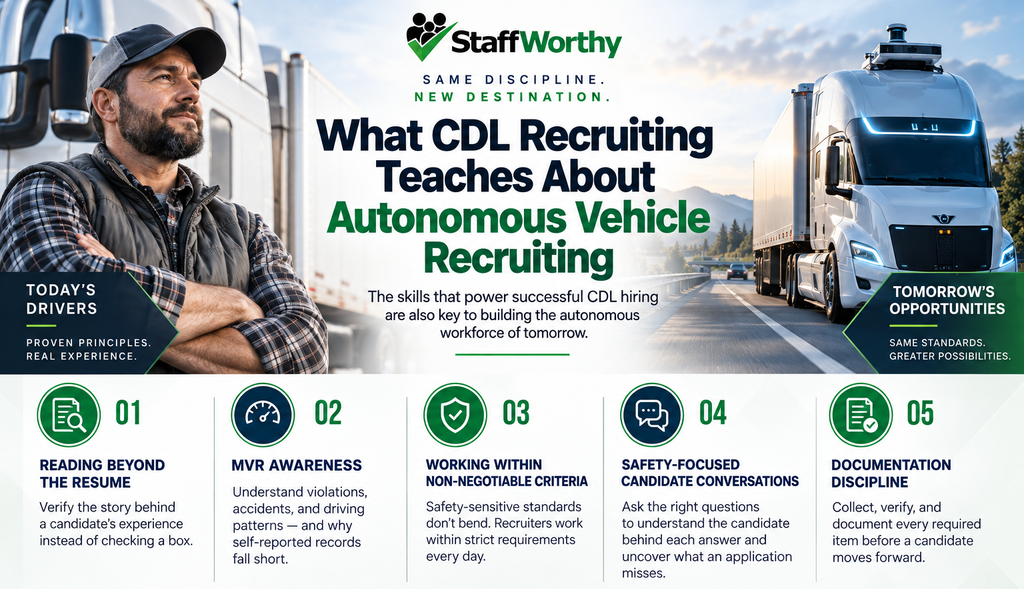
What CDL Recruiting Teaches About Autonomous Vehicle Recruiting
A valid license is not a safe driving record. A candidate with years behind the wheel still might fall short of the standard for a safety-sensitive vehicle operation. CDL recruiters learn this fast.
Commercial transportation hiring runs on hard requirements. A candidate might have years of experience but the wrong type of recent experience. Another might hold the correct license but lack the required endorsement. A single violation might fall outside one carrier’s standards and inside another carrier’s disqualification window.
AV qualification criteria differ from CDL criteria. The screening mindset transfers. Five CDL recruiting capabilities apply directly to AV hiring.
1. Reading Beyond the Resume
Transportation recruiters verify the story behind a candidate’s experience instead of checking a box labeled “three years of driving experience.”
2. MVR Awareness
Recruiters know why employers care about violations, accidents, and driving patterns, and why a self-reported driving record falls short. The employer makes the final decision. Better upstream screening keeps unsuitable candidates out of later stages.
3. Working Within Non-Negotiable Criteria
Safety-sensitive requirements do not bend because a market is tight. Transportation recruiters work inside those boundaries daily, which matters when AV employers set strict rules on age, years licensed, driving record, schedule, commute distance, and background checks.
4. Safety-Focused Candidate Conversations
Experienced recruiters ask enough questions to understand the candidate behind each answer. How does the candidate describe previous incidents? How comfortable are they following structured procedures? How do they respond when something unexpected happens? These conversations surface information an application misses.
5. Documentation Discipline
A recruiter’s belief does not make a candidate qualified. The team collects, verifies, and documents every required item before the file moves forward. The same platform fluency StaffWorthy brings to Tenstreet workflows in trucking keeps this work accurate as AV hiring volume grows.
Screen for Driving Quality Before the Driving Assessment
For some AV roles, candidates must prove their driving ability behind the wheel. California’s standard behind-the-wheel drive test checks whether a driver operates a vehicle safely and follows traffic laws. AV employers add their own assessments and training standards based on the role and technology.
Your recruiting team should evaluate driving quality long before the assessment. Sending every minimally qualified applicant forward moves the screening burden downstream. A stronger process asks one question. What should we confirm before this candidate reaches the client’s assessment? The answer covers driving experience, MVR history, safety orientation, comfort with technology, availability, and client-specific requirements.
Recruiting does not replace the driving assessment. Recruiting makes sure the people who arrive have already cleared a meaningful first layer of qualification. This protects one of the most expensive resources in high-volume hiring: interview and assessment capacity.
At Scale, Screening Quality Matters More
Consider an AV company hiring 75 operators for a new market. The instinct is to generate as many applicants as possible. Volume only helps when your process separates viable candidates from everyone else. Here is a hypothetical campaign of 1,000 applicants:
- 400 meet the initial requirements.
- 200 complete recruiter screens.
- 120 satisfy the full qualification criteria.
- 80 complete the required documentation.
- 50 reach the client assessment.
- 25 receive offers and start work.
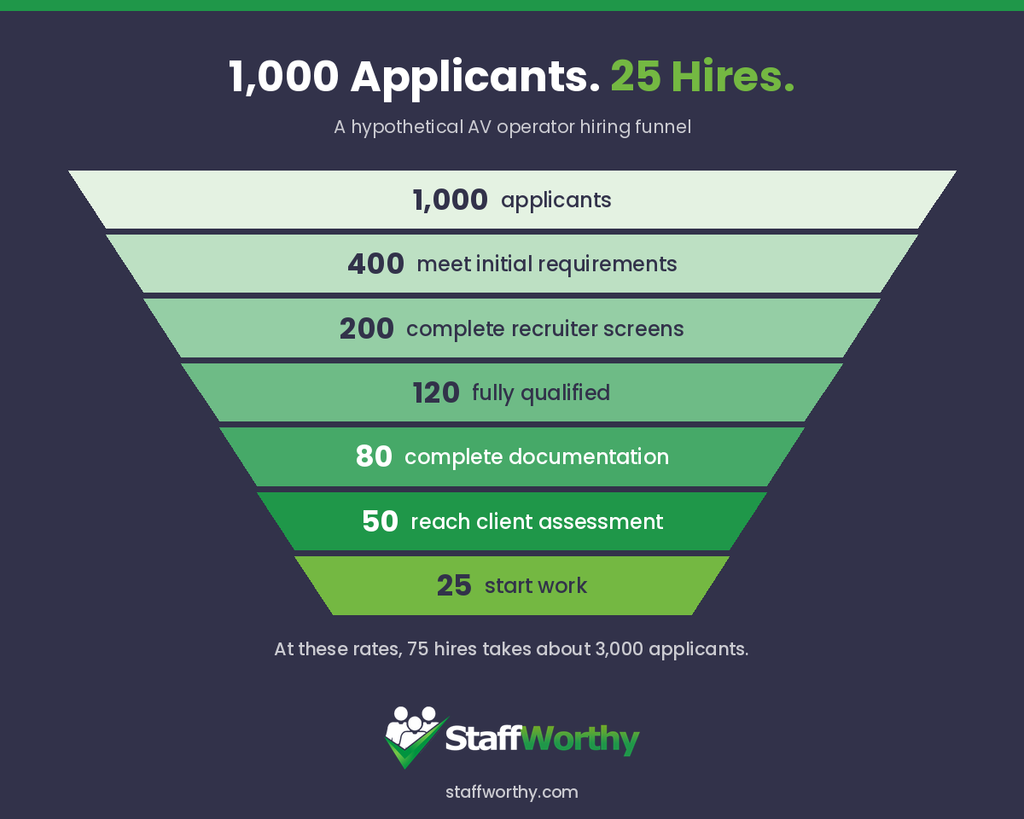
At these conversion rates, reaching 75 hires takes roughly 3,000 applicants. Better conversion at each stage cuts the number you need. Each stage tells you something different. A sourcing problem needs a sourcing solution. A screening problem needs a screening solution. Candidate drop-off needs an engagement solution. A slow assessment process needs an operational solution. Without stage-level visibility, you pay to generate applicants for a process already losing qualified people later on.
The Costliest Candidate Is the Qualified One You Lose
Qualification does not guarantee completion. Candidates apply to multiple jobs. They miss calls, postpone documents, forget assessments, and accept competing offers.
Engagement has to continue after a recruiter marks someone qualified. If your requirements have already eliminated 80% of the applicant pool, losing a qualified candidate to a slow follow-up is expensive.
High-volume AV recruiting requires structured candidate engagement through phone, SMS, and email, easy interview scheduling, clear next steps, and defined follow-up intervals. The objective is to remove avoidable friction between “I’m interested” and “I’m ready for the next step,” with no pressure on the candidate.
Your Recruiting Partner Should Protect Your Operations Team’s Time
A good RPO partner does more than send resumes. The partner makes your team’s time more productive. If an operations manager has 20 interview slots this week, none of those slots should go toward discovering basic facts your recruiting partner should have confirmed:
- Does the candidate meet the driving-history requirement?
- Is the candidate available for the schedule and within commuting distance?
- Did the candidate complete the required documents?
- Does the candidate understand the job and remain interested?
Every question resolved upstream frees your hiring team to evaluate what requires their expertise. For a closer look at partner selection, see our guide to choosing the right RPO company.
Autonomous Vehicle Recruiting FAQs
What does an AV safety driver do?
An AV safety driver sits in the driver’s seat during testing, monitors the automated driving system, and takes control when needed. California requires test drivers to understand the technology’s limits and operate the vehicle safely in every condition the vehicle faces.
What driving record do AV test drivers need in California?
California requires three years of licensed driving with no more than one violation point, no at-fault crash causing injury or death, and no DUI conviction in the past ten years. Each manufacturer also requires drivers to complete a company training program.
Do heavy-duty AV test drivers need a CDL?
California requires heavy-duty AV test drivers to hold the proper license class for the vehicle. For tractor-trailers and other large trucks, the proper class is a commercial license. These drivers must also follow federal hours-of-service rules and enroll in a DOT drug and alcohol testing program.
How is AV recruiting different from CDL recruiting?
The criteria differ. CDL roles center on federal licensing, endorsements, and FMCSA qualification rules. AV roles follow state testing rules and each employer’s standards. Both depend on disciplined MVR review, complete documentation, and fast candidate follow-up.
How many applicants does an AV hiring campaign need?
The answer depends on your conversion rate at each stage. In our hypothetical example, 1,000 applicants produce 25 hires, so a 75-person team needs about 3,000 applicants unless better screening and engagement raise conversion.
Building an AV Workforce? Start With a Partner Who Knows Transportation.
Our CDL background taught us to treat safety standards, qualification requirements, and candidate documentation as core work. Our objective is a qualified shortlist, not the largest stack of resumes. We learn your requirements, turn them into a repeatable screening process, find candidates who fit, and keep those candidates moving.
CDL drivers remain essential, and AV companies are creating a new category of transportation jobs alongside them. The job descriptions are changing. The fundamentals of good transportation recruiting are not.
We combine transportation recruiting experience with high-volume sourcing, recruiter-led screening, and candidate engagement. Whether you are launching a new market, adding operational headcount, or need more recruiting capacity across multiple locations, we build a screening process around your hiring standards and work as an extension of your internal team.
If your operation depends on putting the right people around autonomous vehicles, let’s talk about how StaffWorthy supports your autonomous vehicle recruiting goals.
About StaffWorthy
StaffWorthy is a U.S.-based Recruitment Process Outsourcing provider specializing in CDL driver, owner-operator, and transportation hiring, including autonomous vehicle operations roles. Our recruiter pods work as an extension of your team, managing sourcing, screening, outreach, and pipeline on a flexible model. U.S. project managers work alongside our nearshore delivery team to give you the coverage and response speed to hire at scale.